


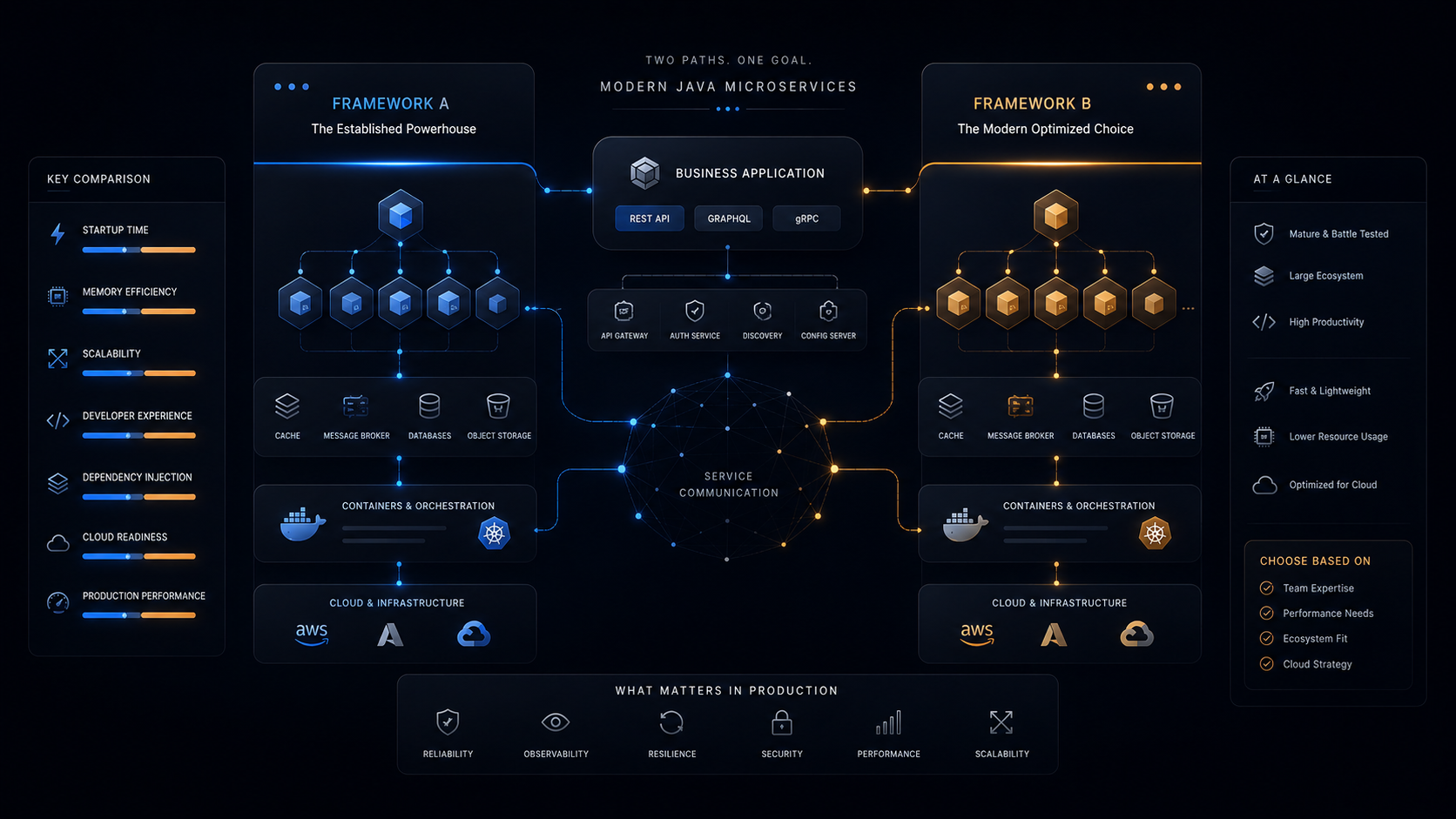
Choosing the right Java framework can significantly impact the performance, scalability, and maintainability of your applications. Spring Boot and Micronaut are two leading frameworks for building modern microservices, each offering a different approach to dependency injection, configuration, and cloud-native development. While both are production-ready, understanding their strengths helps developers make better architectural decisions.
A Tale of Two Philosophies
Spring Boot has become the industry standard for Java backend development. Built on the mature Spring Framework, it emphasizes convention over configuration and provides a massive ecosystem of integrations for databases, messaging, security, cloud platforms, and enterprise services.
Much of Spring Boot's flexibility comes from runtime reflection and automatic classpath scanning. This allows developers to build complex applications quickly, although it can increase startup time and memory consumption.
Micronaut was designed with cloud-native applications in mind. Instead of relying on runtime reflection, it performs dependency injection and configuration processing during compilation. This compile-time approach results in faster startup, lower memory usage, and improved performance, particularly for microservices and serverless deployments.
Startup Time and Memory Performance
One of Micronaut's biggest advantages is its lightweight runtime. Applications generally start much faster and consume significantly less memory compared to equivalent Spring Boot services.
Faster startup is particularly valuable in containerized environments, serverless platforms, and auto-scaling infrastructure where services may be created and destroyed frequently.
Spring Boot typically requires more resources because of its extensive auto-configuration capabilities and reflection-based architecture. However, many enterprise applications consider this tradeoff worthwhile because of the framework's productivity and mature ecosystem.
Developer Experience
Spring Boot excels in developer productivity thanks to its excellent documentation, large community, extensive tutorials, and wide range of official and third-party integrations. Most backend problems already have established Spring solutions.
Micronaut offers a different developer experience by identifying many dependency injection and configuration issues during compilation instead of at runtime. This reduces debugging time and helps developers catch errors earlier in the development cycle.
Spring Boot prioritizes developer convenience, while Micronaut prioritizes runtime efficiency.
Testing and Reliability
Both frameworks provide excellent support for unit and integration
testing. Spring Boot includes a mature testing ecosystem with tools like
@SpringBootTest for loading application contexts during tests.
Because Micronaut applications start much faster, running integration tests often requires less time and fewer resources. Faster feedback loops can improve developer productivity, especially in larger projects.
Reactive and Cloud-Native Development
Modern backend applications increasingly rely on containers, orchestration platforms, and distributed systems. Both frameworks support reactive programming, cloud deployments, and microservice architectures.
Spring Boot benefits from the mature Spring Cloud ecosystem, offering solutions for service discovery, distributed configuration, messaging, gateways, and resilience patterns.
Micronaut focuses on lightweight cloud deployments with built-in support for AWS, Azure, Google Cloud, Consul, Eureka, Kubernetes, and GraalVM native images, making it attractive for modern cloud-first applications.
When Should You Choose Each Framework?
Choose Spring Boot If You:
- Already have experience with the Spring ecosystem.
- Need enterprise integrations and mature tooling.
- Work on large business applications with complex requirements.
- Value community support and extensive documentation.
Choose Micronaut If You:
- Need extremely fast startup times.
- Want lower memory consumption.
- Are building microservices or serverless applications.
- Plan to use GraalVM native images.
- Prefer compile-time dependency injection.
Final Thoughts
Spring Boot and Micronaut are both outstanding Java frameworks, but they target different priorities. Spring Boot emphasizes productivity, ecosystem maturity, and enterprise capabilities, while Micronaut focuses on performance, startup speed, and cloud-native efficiency.
Rather than choosing based on popularity alone, evaluate your project's scalability requirements, infrastructure constraints, and long-term maintenance goals. Selecting the framework that aligns with your architecture will provide the greatest value as your application grows.